

Play Plinko 1000 Demo
General Information
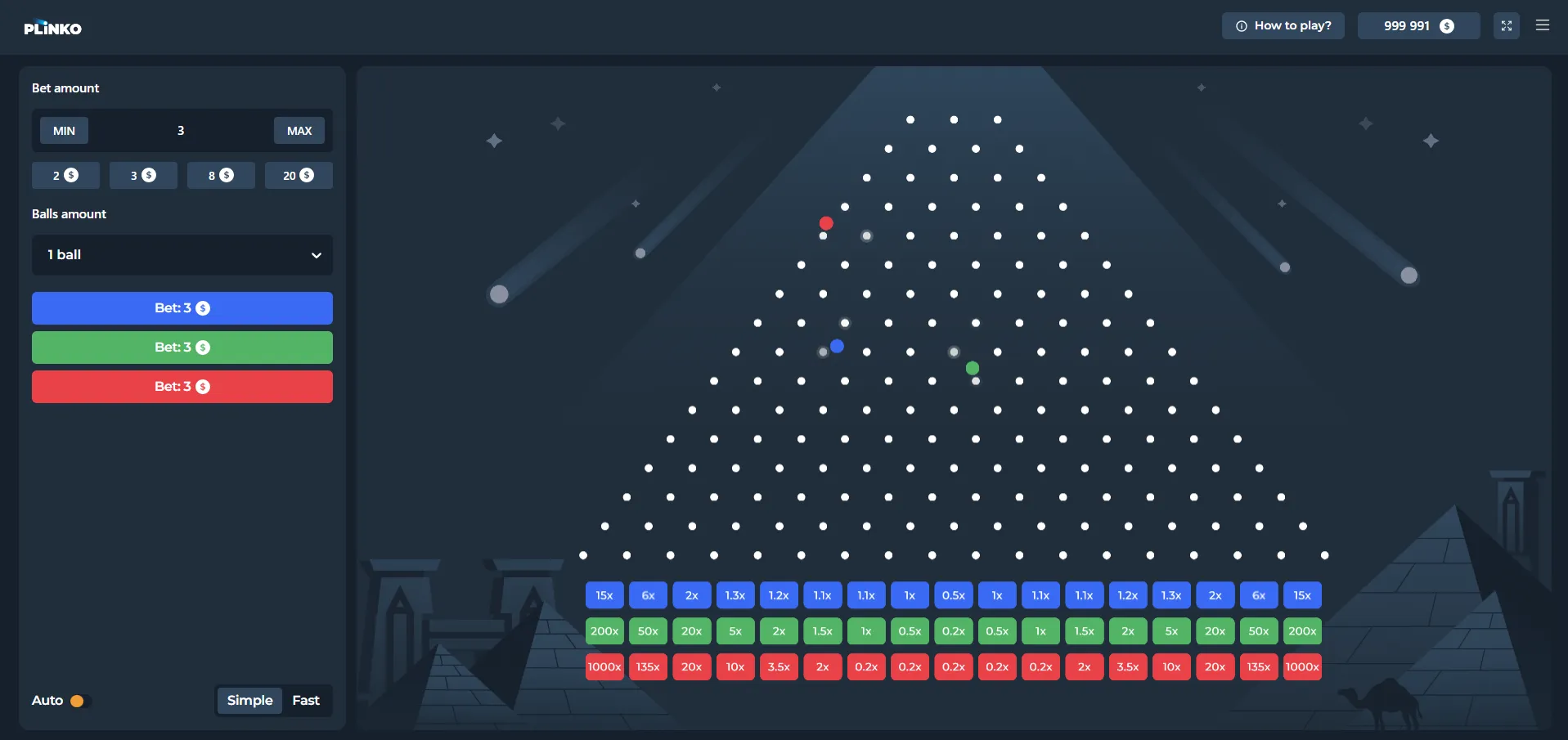
Plinko 1000 is a classic plinko online game developed by InOut Games, the studio often referred to simply as InOut. It was released in July 2023 and belongs to the traditional Plinko category rather than the hybrid or crash-Plinko formats: there is no rising multiplier to cash out, no buy feature and no bonus round. A ball is released from the top of a peg pyramid, it bounces down through 16 rows, and the slot it lands in decides the payout. The visual theme is ancient Egypt, with pyramids silhouetted against a starry night sky behind the board, which sets it apart from the plain neon or fruit designs used by most Plinko titles.
The RTP of Plinko 1000 is 96%, which is the return InOut Games lists for the title. That gives a house edge of 4%. Operators can sometimes run a different configuration of a game, so the figure shown in the in-game rules panel at your casino is the one that applies to your session, and it is worth checking before you play plinko for real money. Volatility is not a single fixed value here because it changes with the colour of ball you choose: blue balls are low volatility, green balls are medium, and red balls are high. Across a typical session that mixes colours, the game plays as low to medium volatility.
Plinko 1000 is distributed through international and crypto-focused online casinos that carry the InOut catalogue. One of the larger operators offering it is BC.Game, which holds an Anjouan (Union of the Comoros) licence, number ALSI-202410011-FI1. We could not confirm the game at any casino licensed by the UK Gambling Commission, so players in Great Britain should only play at a UKGC-licensed site and should check whether the title is offered there before searching elsewhere. InOut Games also publishes a list of restricted countries, so availability depends on both the operator and your location. Players in the United States should note that real-money availability is set state by state and by operator.
InOut Games is a business-to-business studio that builds crash games, instant games and casual titles for online and crypto casinos. Its games are localised into more than 15 languages, support multiple currencies, and come with operator tools for setting limits and reviewing player rounds. The studio is best known for Chicken Road and Chicken Road 2.0, and its wider catalogue includes Plinko Aztec, Dragon Pots, Ice Fish, Wheel Out and a number of mine-style and slot-style releases. InOut Games has collected industry recognition at SiGMA events for its crash game portfolio and as a rising studio, and it has been named game provider of the year at a 2026 industry conference. Within that catalogue, inout plinko 1000 is one of the earlier and simpler releases, and Plinko Aztec is its more feature-heavy sibling in the inout plinko range.
Key Features at a Glance
| Feature | Plinko 1000 |
|---|---|
| RTP | 96% |
| House edge | 4% |
| Max multiplier | 1,000x (red ball, two outer slots) |
| Min bet | 0.10 per ball (0.01 on some operator builds) |
| Max bet | 200 per ball |
| Risk levels | Blue (low) / Green (medium) / Red (high) |
| Rows / pegs | 16 fixed rows, 17 landing slots per colour |
| Multiplier range | Blue 0.5x to 15x / Green 0.2x to 200x / Red 0.2x to 1,000x |
| Balls per bet | 1, 5, 10 or 50 |
| Provably fair | Not confirmed |
| Third-party audit | Not disclosed |
| Auto-bet | Yes |
| Fast play | Yes |
| Demo available | Yes (playable on this page) |
| Mobile compatible | Yes |
Game Review
How the Plinko 1000 Game Works
A round of this plinko online game starts with three choices: the stake per ball, the ball colour, and the number of balls to release (one, five, ten or fifty). The stake is charged per ball, so fifty balls at 1.00 each cost 50.00 in a single click. When you press play, each ball drops from the apex of the pyramid and is deflected left or right at every one of the 16 peg rows before settling into one of 17 slots at the bottom.
Below the board sit three stacked rows of multipliers, one blue, one green and one red. The colour of the ball decides which row is read: a blue ball pays from the blue row, a green ball from the green row and a red ball from the red row. The payout is the stake per ball multiplied by the value in that slot. The lowest values sit in the centre and the highest at the two outer edges, and because a ball has to be deflected the same way almost every time to reach an edge, the centre slots collect the large majority of drops. You can also send several colours in one round, for example ten blue balls and five red ones.
Risk Levels Explained
The blue row runs from 0.5x to 15x and has only one slot that returns less than the stake, so most blue balls pay back something close to the bet or slightly more. It suits players who want a long session from a small bankroll. The green row runs from 0.2x to 200x, with more sub-1x slots in the middle and a much higher edge payout, which fits players who accept regular small losses in exchange for occasional mid-sized hits. The red row runs from 0.2x to 1,000x and has five losing slots across the centre, so the bulk of red balls return a fraction of the stake. Red is built for players chasing the top multiplier with a bankroll that can absorb long dry runs.
The Mathematics
For every $100 wagered, Plinko 1000 returns approximately $96 over many rounds, and the house retains $4 of every $100 wagered on average. The expected cost of a session follows the formula: expected loss = house edge % × rounds per hour × average bet.
At a manual pace of around 600 single-ball drops per hour and a $1 stake, the expected loss is 4% × 600 × $1 = $24 per hour. At a $5 stake, the same pace gives 4% × 600 × $5 = $120 per hour. Multi-ball drops raise this quickly: ten balls per click at $1, repeated 300 times an hour, means 3,000 balls and an expected loss of $120 per hour at a stake that looks small on screen.
Reaching 1,000x requires a red ball to land in one of the two outer slots. If each peg acts as an even left or right split, the chance of hitting one specific edge after 16 rows is 1 in 65,536, and the chance of hitting either edge is 1 in 32,768. InOut Games does not publish slot-by-slot probabilities, so this is a model rather than a published figure, but it shows the scale: at $1 per red ball, a player would expect to stake around $32,768 between max multiplier hits on average.
Fairness and Verification
Provably fair status: not confirmed. Plinko 1000 does not offer a documented seed and hash verification tool that players can use to check individual rounds, and InOut Games does not name an independent testing laboratory for this title. Results are generated by the provider’s random number generator, and InOut gives operators back-office tools to review player rounds, but that review sits with the casino rather than the player. Our fairness verdict is unverified: there is no evidence of manipulation, but a player cannot independently confirm a result, which places the game behind provably fair alternatives on transparency.
How It Compares
Any plinko review that puts value first has to measure Plinko 1000 against the two best-known alternatives. BGaming’s Plinko returns 99%, three points more than Plinko 1000, offers Low, Normal and High risk with 8 to 16 adjustable rows, caps at 1,000x and is provably fair. It is the better choice for players who care most about long-run value and round verification. Spribe’s Plinko returns 97%, uses a similar colour-based risk control (green, yellow and red), offers 12, 14 or 16 rows, tops out at 555x and is also provably fair. Players who like the colour approach but want verification should look there, while Plinko 1000 remains the option for those who want a higher 1,000x ceiling and the ability to mix colours in one drop.
